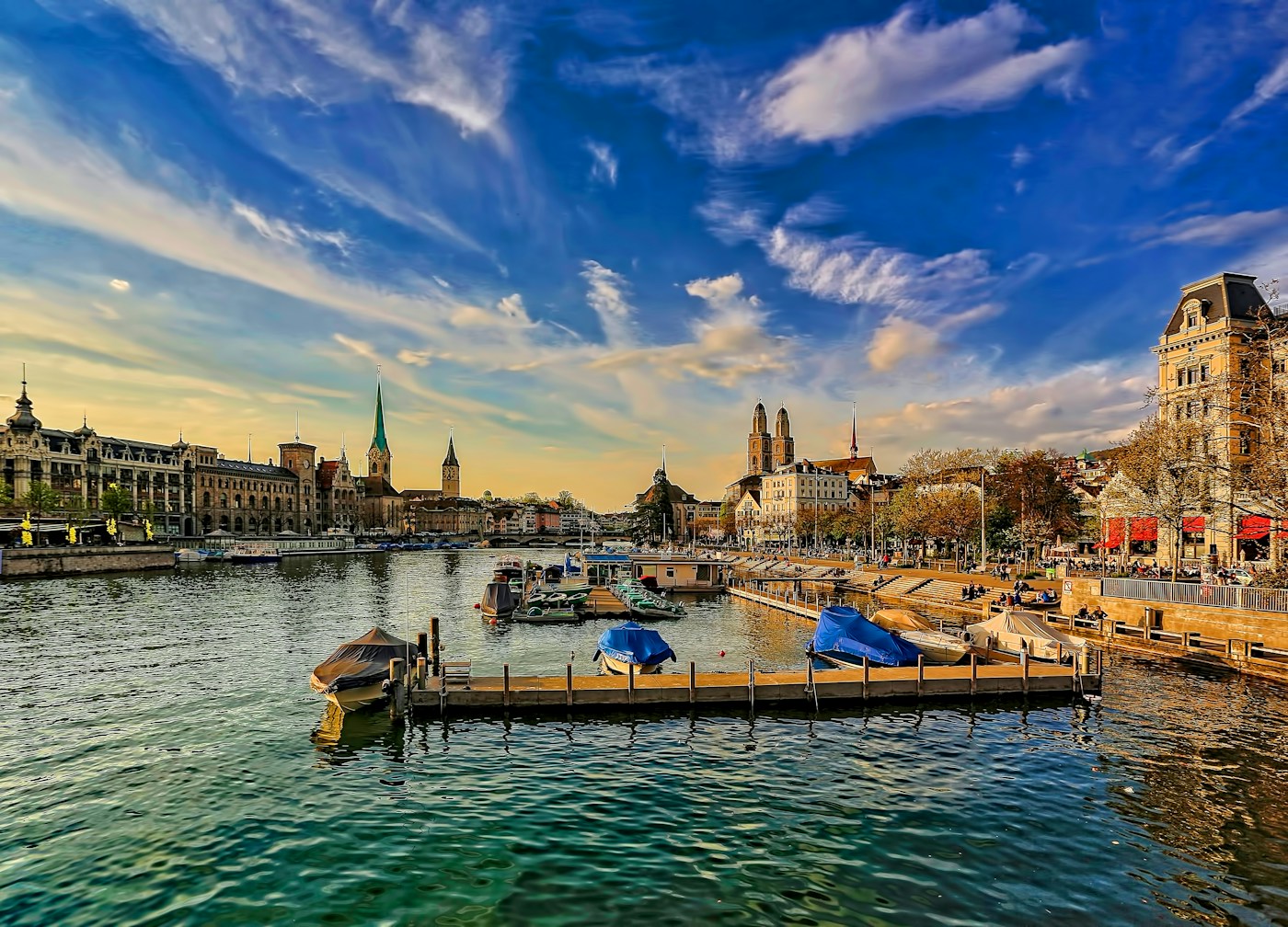
Basel vsZurichthe independent comparison · index 8.4 vs 8.7
Basel and Zurich sit 55 miles apart on the same federal tax map, share German as the working language, and run identical Swiss healthcare, transit, and visa rules. Zurich is the financial capital, larger, denser, with the deepest banking and tech recruiter pool in Europe. Basel is the pharma capital, smaller, cheaper on rent, and sits where Switzerland, Germany, and France meet at a single tram stop. The math runs different ways depending on the industry.
8.4
Index
Basel
8.7
Index
Zurich
№ 01 , The Verdict
Which city wins.
Same country, same currency, same tax federalism. The verdict turns on industry, rent, and the size of the international pool.
The Verdict
Zurich wins on balance.
Zurich wins on the index by 0.3 of a point, on salary by 8 to 14 percent across mid level roles, and on the international community density. Basel wins on rent by 600 dollars a month all in, on commute simplicity, and on the cross border lifestyle that puts France and Germany inside the tram network. The call hinges on industry: pharma sits in Basel, finance and tech sit in Zurich.
Zurich
on the everycity index 2026
Basel scored 8.4 on the everycity index in 2026, Zurich scored 8.7. Both cities share the Swiss franc, the federal direct tax table on top of the cantonal layer, the universal Swiss health system funded by mandatory private insurance, and the same SBB national rail backbone. The split lives in industry, rent, and the international density. For the deep read, see the Basel city profile and the Zurich city profile.
If your role is in pharma, life sciences, chemical engineering, or any function that benefits from the Roche, Novartis, and Lonza cluster, Basel wins. If your role is in finance, fintech, software, or insurance, Zurich wins on recruiter pool depth, salary, and the conference circuit. The highest paying cities ranking places Zurich at 9.2 and Basel at 8.6, both in the global top 10.
Twelve line items priced in May 2026 for a single resident in a central one bedroom. Green text marks the cheaper city per line.
Line item
Basel
Zurich
Rent, central one bedroom
2,150 dollars
2,750 dollars
Rent, suburban two bedroom
1,950 dollars
2,450 dollars
Family three bedroom rent
2,850 dollars
3,650 dollars
Groceries, single
485 dollars
510 dollars
Public transport pass
85 dollars
92 dollars
Utilities, average
215 dollars
225 dollars
Internet, 500 Mbps
55 dollars
58 dollars
Coffee, take away
4.80 dollars
5.20 dollars
Beer, bar
8.20 dollars
8.80 dollars
Dinner for two, mid
115 dollars
135 dollars
Gym membership
78 dollars
92 dollars
Monthly all in, single
3,650 dollars
4,250 dollars
Basel is cheaper across all twelve cost lines. The rent gap is the largest item: a central one bedroom in Kleinbasel runs 2,150 dollars; the equivalent in Kreis 4 or Kreis 5 runs 2,750. The 600 dollar gap on rent compounds to 7,200 dollars a year. The family three bedroom gap of 800 dollars a month compounds to 9,600 a year. Even the takeaway coffee runs 8 percent cheaper in Basel.
The all in monthly figure of 3,650 dollars in Basel versus 4,250 in Zurich is the headline. Both figures place these cities among the most expensive in Europe; only Geneva and London sit in the same band. The cheapest cities ranking places neither city inside the top 500. The salary math is what makes Switzerland work: median software engineering salaries clear the rent line by 4 to 6 multiples.
For the franc to home currency math, Wise handles the line at within 0.4 percent of the mid market rate. For the first month while waiting for the rental contract, Booking.com covers both cities. The cost converter tool takes your salary in either direction.
Three quiet Swiss costs. Rentals require a three month deposit held in a blocked bank account. Health insurance is mandatory, not employer paid, and runs 380 to 520 francs per adult per month depending on the deductible. The Serafe radio and television fee runs 335 francs per household per year. The relocation checklist has the line by line.
№ 03 , Safety Side by Side
Streets, day and night.
The 10 point safety read across the four sub axes the methodology weights equally.
Safety axis
Basel
Zurich
Overall
8.8
8.9
Solo female, day
9.0
9.1
Family with kids
9.2
9.2
After dark, central
8.4
8.6
Traffic safety
9.0
8.8
Both cities sit inside the global top 15 on overall safety. The 0.1 point gap is statistical noise; on the ground Basel and Zurich both clear the bar for late night walks, school commutes, and solo female travel. Basel records the higher traffic safety score because the city center is largely tram and pedestrian; Zurich's higher density and bigger nightlife footprint pulls its after dark score 0.2 above.
For the new arrival, SafetyWing covers either city for the first 90 days while the mandatory Swiss insurance enrollment is sorted. The solo female safety ranking places both inside the global top 20. The safest cities ranking ranks Zurich at 8.9 and Basel at 8.8.
№ 04 , Weather Side by Side
The climate trade off.
Annual averages, the rainy day count, and the count of days in the comfort band.
Climate
Basel
Zurich
Climate type
Oceanic (Cfb)
Oceanic (Cfb)
Summer high
78F July
76F July
Winter low
32F January
30F January
Rainy days per year
125 days
133 days
Comfort band days
175 days
168 days
Snow days per year
12 days
21 days
Basel runs marginally warmer, drier, and with less snow than Zurich. The 2 degree summer gap is invisible day to day; the 9 day snow gap and 8 day rain gap is the lived difference. Basel sits in the Upper Rhine valley at 850 feet of elevation; Zurich sits on its lake at 1,340 feet, which is the elevation that drives the colder winters. Both cities run the central European oceanic climate with four genuine seasons, mild summers, and cold but not extreme winters.
For climate matching, the climate match tool finds cities with similar profiles. The warm winter ranking places neither inside the European top 100. The best weather ranking places both inside the European top 80 on summer comfort. The climate atlas maps both into the oceanic band.
№ 05 , Jobs and Salary
Who pays better, after tax.
Median salaries for four mid level roles, the headline tax bands, and the cantonal layer that drives the take home gap.
Role and tax
Basel
Zurich
Software engineer, mid
115,000 dollars
128,000 dollars
Senior engineer
155,000 dollars
175,000 dollars
Pharma scientist, mid
138,000 dollars
118,000 dollars
Finance, VP track
210,000 dollars
265,000 dollars
Federal tax, top rate
11.5 percent
11.5 percent
Cantonal tax, top rate
26.5 percent
23.1 percent
Zurich pays 8 to 14 percent more on the gross line for tech and finance roles, on the back of the larger employer cluster. Basel pays 17 percent more on the pharma line, driven by the Roche and Novartis premium. The cantonal income tax structure favors Zurich at 23.1 percent on the top bracket against Basel Stadt at 26.5 percent; with the federal 11.5 percent layer, the effective rate for a single filer on 200,000 francs runs 27 to 29 percent in Zurich and 30 to 32 percent in Basel. The tax calculator tool runs your number against both cantons.
The major employers in Basel are Roche, Novartis, Lonza, Syngenta, Clariant, the regional banks UBS and Credit Suisse legacy operations now consolidated under UBS, and the cluster of biotech firms that surround the BaselArea innovation campus. The major employers in Zurich are UBS, Zurich Insurance, Swiss Re, Credit Suisse legacy operations now under UBS, the regional offices of Google, Microsoft, IBM, Disney Research, the cluster of fintech firms anchored at Trust Square and F10, and the ETH Zurich spinout ecosystem. The highest paying cities ranking places Zurich at 9.2 and Basel at 8.6, both inside the global top 10.
№ 06 , Lifestyle Side by Side
Food, nightlife, and culture.
The qualitative axes scored on the same 10 point scale the index uses elsewhere.
Lifestyle axis
Basel
Zurich
Nightlife
7.4
8.2
Walkability
9.0
8.8
Public transit
9.4
9.6
Food scene
8.0
8.6
Cultural breadth
8.4
9.0
Zurich wins lifestyle on density and on nightlife in particular. The Kreis 4 and Kreis 5 bar count, the late train service to 4 am on weekends, and the international DJ circuit at Hive and Zukunft put the Zurich nightlife rating 0.8 above Basel. Basel wins on walkability marginally because the old town fits inside a 12 minute walk end to end; Zurich's larger footprint requires the tram for cross town moves. The Basel art museum cluster including the Kunstmuseum, the Fondation Beyeler, and the Vitra Design Museum across the German border at Weil am Rhein punches well above the city size. The cities for foodies ranking places Zurich at 8.6 and Basel at 8.0. The nightlife ranking places Zurich inside the European top 30.
№ 07 , Practical Side by Side
Visa, language, and transport.
The boring section that decides whether the move actually happens.
Practical
Basel
Zurich
Visa difficulty (1 to 10)
8
8
Working language
German (Swiss German)
German (Swiss German)
English in business
High
Very high
Internet speed
210 Mbps
225 Mbps
Walk score
9.0
8.8
Public transit (SBB plus tram)
9.4
9.6
Cross border tram access
Yes (Germany, France)
No
Visa rules are federal Swiss and apply equally to both cities. Switzerland is not in the EU but is inside Schengen and the EFTA. EU and EFTA citizens enter on the free movement framework. Third country nationals face the cantonal quota system; Zurich and Basel Stadt both run tight quotas with the highly qualified specialist exception. The intra company transfer route runs faster for both. The 2026 visa guide covers each pathway.
Healthcare. The Swiss system is the same in both cities: mandatory private insurance funded by the individual, premiums between 380 and 520 francs per adult per month, deductibles from 300 to 2,500 francs. The University Hospital Basel and the University Hospital Zurich are both inside the European top 30 on cardiology, oncology, and trauma. Both cities score 9.0 on the everycity health methodology. For the first 90 days, SafetyWing covers the gap.
Education. International schools in Zurich include the Inter Community School, the Zurich International School, and the Swiss International Scientific School; tuition runs 32,000 to 48,000 dollars a year. Basel runs the International School Basel and the Academia International School; tuition runs 28,000 to 42,000. The Swiss public school system is excellent and free; the language barrier is the gating factor. The relocating with kids guide walks the calendar.
Move logistics. The shipping container math from the US East Coast to either city runs 5,800 to 8,200 dollars on a 20 foot. The customs clearance process is the same federal Swiss process. Pet relocation runs the EU pet passport route. The relocation checklist covers both end to end. Basel airport is the cross border EuroAirport Basel Mulhouse Freiburg with 8.5 million passengers a year; Zurich airport handles 31 million.
The longer term resident question. Swiss permanent residence opens after 10 years of B permit residence, reduced to 5 years for EU and EFTA citizens and US treaty list nationals. Swiss citizenship adds another 2 to 4 year cantonal residence requirement. The visa to citizenship guide tracks the multi year pathways.
№ 08 , The Final Word
The read for each reader.
For the pharma scientist, the chemical engineer, the biotech founder, or any worker whose career sits inside the Roche, Novartis, or Lonza orbit, Basel wins. The cluster, the salary premium, and the cross border lifestyle all favor Basel.
For the software engineer, the fintech operator, the asset manager, or any worker whose career sits inside the UBS, Swiss Re, Google Zurich, or ETH spinout orbit, Zurich wins. The depth of the recruiter pool, the late night culture, and the cantonal tax advantage all favor Zurich. The deep dive guide spends a chapter on each.
One reading note. The Basel versus Zurich comparison is one of 25,000 we maintain on the same methodology. The underlying scores feed the rankings on highest paying cities, safest cities, remote work, and families. The numbers refresh quarterly. If the verdict here clashes with your lived experience, the methodology page walks the weights.
For the deeper comparison set, the comparisons index tracks every two way matchup. The relocation score tool takes your current city and target city and returns a 1 to 100 fit score. The where should I live quiz is the entry point for readers without a target.
№ The Dispatch
Numbers, every Tuesday.
One city, one comparison, one ranking. No fluff. Unsubscribe with one click.
Sources, May 2026. Numbeo cost of living index May 2026 · Mercer Cost of Living Survey 2026 · OECD Income Distribution Database 2025 · Swiss Federal Statistical Office BFS 2025 · Swiss Federal Tax Administration ESTV 2025 · Cantonal tax tables for Basel Stadt and Zurich 2026 · Speedtest Global Index April 2026 · EIU Safe Cities Index 2024 · MeteoSwiss climate normals 1991 to 2020 · Glassdoor and Levels.fyi for salary medians. First published May 15, 2026. Last updated May 15, 2026.