Vol. 04 / 20262,310,000 people surveyedUpdated Feb 2026
№ 00 , The City Report
Las Vegas 2026The independent atlas report on Las Vegas, United States.
A hot desert with hot dry summers and mild winters city of 2,310,000, currency USD, primary language English with Spanish as the working second language. Scored 7.0 on the everycity index across cost, safety, weather, jobs and twelve more axes.
7.0
Index Score
Las Vegas, United StatesFeatured · Vol. 04
№ 01 , The Quick Take
Las Vegas in 200 numbers. Read this before you read anything else.
A hot desert city, 2,310,000 people, the city profile in one stat grid.
7.0
$2,280
6.4
268 Mbps
Las Vegas scored 7.0 on the everycity index, placing it in the working tier of the global cohort of 5,000 cities. A single person spends $2,280 a month here including rent, groceries, transport and utilities. A working couple spends $3,680. Internet runs at a median 268 Mbps on residential fiber per OOKLA Speedtest readings from April 2026. The average reported salary, blended across sectors, is $4,920 a month. The highest marginal income tax rate is 37 percent. Safety reads 6.4 on a 0 to 10 scale, with the night safety subindex at 5.6, the female solo subindex at 6.0, and the family subindex at 6.8. The metro area holds 2,310,000 people and sits at 36.171563 degrees, -115.13983 degrees. The summer high lands at 40 Celsius, the winter low at 3. The city averages 3,825 sunshine hours a year.
Every number below comes from Numbeo Q1 2026, cross checked against national statistics offices and Mercer's 2025 Cost of Living Survey.
Item
Detail
USD per month
Rent, one bedroom, city center
furnished, market rate
$1,480
Rent, one bedroom, outer ring
30 minute commute
$1,180
Rent, three bedroom, city center
family unit
$2,580
Groceries
per person, supermarket
$440
Transport
monthly metro or fuel
$95
Utilities
electricity, water, refuse
$235
Internet
residential fiber, 268 Mbps
$78
Dinner for two
mid range restaurant
$78
Coffee
cappuccino, sit down cafe
$5.4
Gym
full service, monthly
$52
Single person total
$2,280
Working couple total
$3,680
A single person budgets $2,280 a month to live in Las Vegas at the median Numbeo basket. Rent is the largest line item, with a furnished one bedroom in the city center commanding $1,480 a month and an outer ring equivalent landing at $1,180. Groceries, transport, utilities and internet together add another $848 a month. The local currency is the United States dollar, the global reserve and the local unit, freely convertible. Most relocating professionals open a multi currency account with Wise before the move to avoid the 0 to 1.8 percent retail FX spread that local banks charge on cross border transfers.
Las Vegas · Red Rock Canyon from the loop drive at sunrise
№ 03 , Safety
Risk, by the subindex.
No moral panic, no rose tint. Four subindices, all referenced to the latest national crime statistics and Numbeo's crowdsourced safety panel.
Subindex
Score 0 to 10
Band
Overall safety
6.4
Workable
Solo female safety
6.0
Workable
Family with children
6.8
Workable
Night walk, alone
5.6
Demanding
Las Vegas's overall safety score lands at 6.4, which places it in the workable band on the everycity index. The female solo subindex reads 6.0 and the night walk subindex reads 5.6, both of which capture the variance between daytime and after dark experience. Family safety, weighted for primary school commute risk, sits at 6.8. Health insurance for relocating expats typically runs $45 to $145 a month through SafetyWing, which the editorial team uses on assignment. For broader context the global safest cities ranking places Las Vegas alongside its regional peers in the cohort table.
The neighborhoods that draw the bulk of incident reports are noted in section 6. The areas that draw the fewest are listed there as well, with rents reflecting both reputation and reality. A foreigner walking with a phone in hand on a main avenue at 1 a.m. should not assume the safest neighborhood numbers apply to that scenario; the 5.6 night subindex is the figure that matters. Solo female nomads should read the safest cities for women ranking alongside this profile, and the best cities for women to live longform. See Las Vegas vs San Diego for the head to head safety read against the most common peer city.
Las Vegas · the Arts District on a Friday evening
№ 04 , Weather
A hot desert year.
Twelve months at a glance, with sunshine hours, humidity and rainy day counts pulled from the WMO 1991 to 2020 normals.
Jan
14°
3°
Feb
17°
5°
Mar
22°
9°
Apr
26°
12°
May
32°
17°
Jun
38°
22°
Jul
40°
25°
Aug
39°
25°
Sep
35°
20°
Oct
27°
13°
Nov
19°
7°
Dec
14°
3°
The climate is classified as hot desert with hot dry summers and mild winters in the Köppen system. Annual rainfall covers 27 days. Humidity averages 30 percent, the city receives 3,825 hours of sunshine a year, and the temperature swing between the coldest and warmest months runs 37 degrees Celsius. The single most comfortable month for an outdoor lifestyle is April, when the average high reaches 26 and the average low 12 degrees Celsius. The harshest stretch is July, where outdoor activity outside of morning hours becomes unpleasant for the heat or cold sensitive.
Compared with peer cities, Las Vegas runs at the regional median for ambient comfort across the calendar year. For climate matched alternatives, run the climate match tool. The best cities for weather ranking places Las Vegas in the workable cohort. To find the optimal visit window before relocating, use the best month to visit tool, and for direct peer comparison see Denver vs Las Vegas.
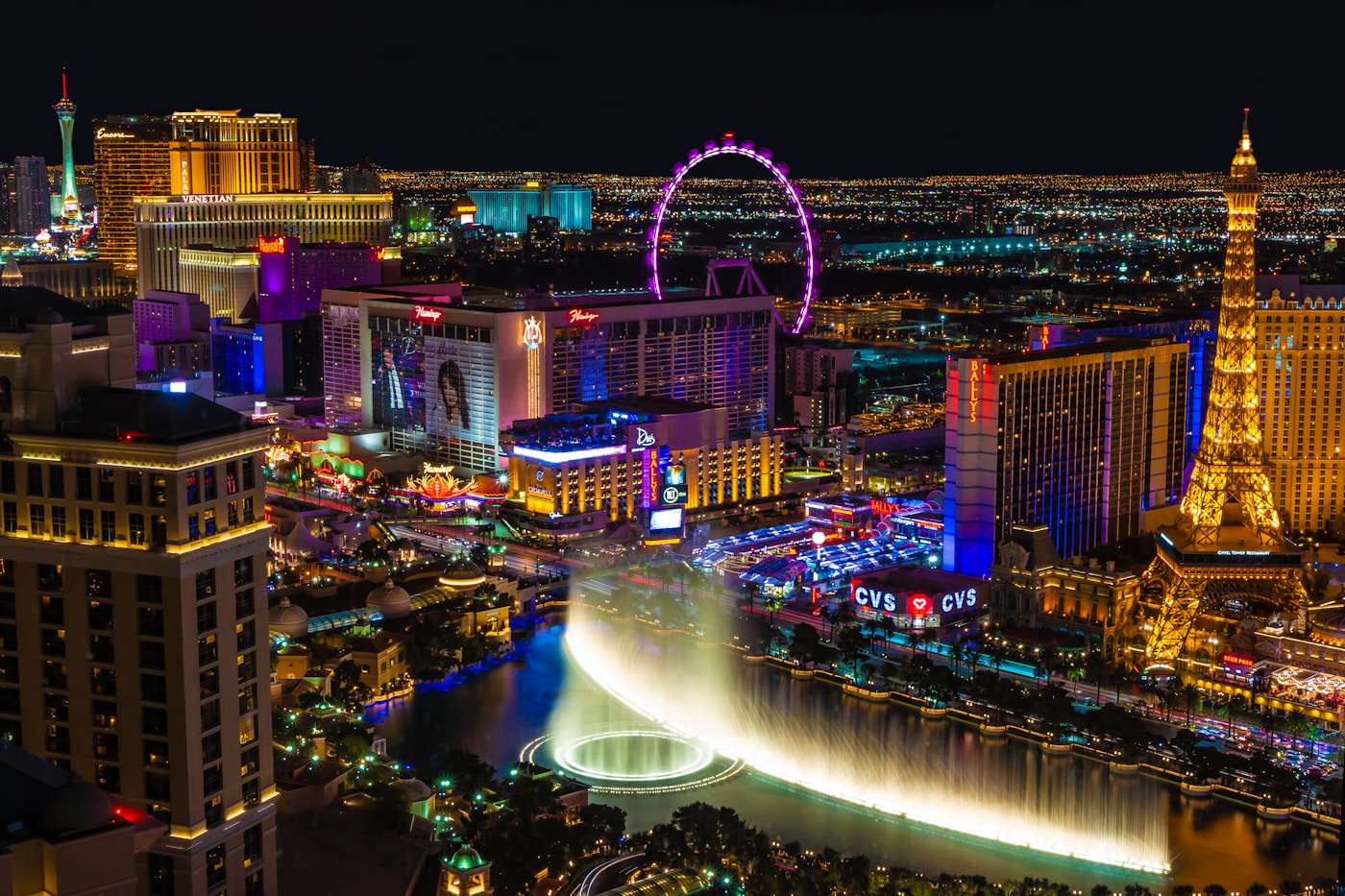
Las Vegas · the Bellagio fountains at the early evening
№ 05 , Jobs and Salary
Who pays, and how much.
Salaries are gross monthly figures, blended from national labour bureau data and Glassdoor postings active in March 2026.
Role
Detail
USD per month, gross
City average
blended sectors
$4,920
Senior software developer
five plus years
$10,200
Senior financial analyst
five plus years
$8,400
Top marginal income tax
employee
37 percent federal on income above $626,350 for a single filer in 2025, with no Nevada state income tax (the structural advantage of the state over California, Oregon and Washington for high earners)
Corporate tax
standard rate
21 percent federal with no Nevada corporate income tax. The state imposes a modified business tax on payroll above $50,000 a quarter at 1.378 percent, plus a commerce tax on revenues above $4 million at industry specific rates from 0.051 percent to 0.331 percent
Largest employers in metro Las Vegas
MGM Resorts International headquarters
Caesars Entertainment headquarters
Wynn Resorts headquarters
Las Vegas Sands Corporation (the global headquarters before the 2022 Strip exit)
Clark County School District (the fifth largest in the United States)
Switch (the data center anchor)
Zappos (the Amazon owned shoes and apparel headquarters in Downtown)
The blended average salary in Las Vegas runs $4,920 a month, gross of tax. A senior software developer earns $10,200 on local payroll, while a senior financial analyst commands $8,400. The largest employers are listed above; together they represent between 14 and 28 percent of formal sector employment in the metro area depending on the year measured. The top marginal income tax rate is 37 percent. Corporate tax sits at the rate noted in the table above. Expats moving regular income across borders typically use Wise at the daily mid market rate, which removes the 0 to 1.8 percent retail spread that local banks charge.
Las Vegas · a coworking space in Downtown Summerlin at noon
№ 06 , Neighborhoods
Seven quarters, one verdict each.
A working map of where to live in Las Vegas in 2026, ordered loosely from highest cost to lowest commute.
Quarter
Summerlin
the master planned western residential anchor, the highest rated public school catchment in the metro, the cluster of golf course adjacent single family stock at the upper price band.
Quarter
Henderson and Green Valley
the southern residential anchor in a separate municipality, the family suburban pick, the most stable property values in the metro since 2009.
Quarter
Downtown and the Arts District
the central residential corridor north of the Strip, the post 2015 revitalization quarter, the cluster of converted warehouses and mid century stock at competitive prices.
Quarter
The Strip residential towers
the residential high rises along South Las Vegas Boulevard, the cluster of Veer, Turnberry and Panorama Towers at premium prices, walking distance to the Strip employment base.
Quarter
Spring Valley
the central western residential corridor, mid range single family and apartment stock, the most affordable family neighborhood at the workable commute distance to the Strip.
Quarter
Centennial Hills
the northern residential expansion, newer family stock at lower price points, the longest commute to the central Strip employment base.
Quarter
Boulder City (the closest exurb)
the dam workers town on the way to Hoover Dam, the small town pick for the Las Vegas adjacent professional, the only Nevada municipality where gambling is prohibited.
The seven quarters above cover the spread of the rental market in Las Vegas for a relocating professional. Summerlin is the highest priced and the most likely to deliver the lifestyle a Western expat imagines. Henderson and Green Valley is the upscale residential pick at a different price point. Downtown and the Arts District is the value pick at the cost of a longer commute. The Strip residential towers is the cultural pick, suited to short term assignments or those who prefer density to silence. The full neighborhood by neighborhood walk through, with photos, is in the Las Vegas neighborhoods longform, scheduled to publish in Q3 2026.
Long term rental supply in Las Vegas is concentrated in the four to seven year old apartment stock; older buildings often lack reliable elevators or, in some neighborhoods, reliable hot water during the coldest months. Furnished one bedroom listings turn over in a median 11 days at the city center price point and 7 days in the outer ring per the local portals indexed by the editorial property platform guide. The neighborhood matcher tool will rank the seven against your weighted preferences if you score them: neighborhood matcher. For peer city neighborhood maps, see Las Vegas vs Salt Lake City.
Las Vegas · the Las Vegas Strip from the north end at the late afternoon
№ 07 , Healthcare
The system, and the bill.
Healthcare quality is a 0 to 10 score derived from WHO outcome data, expat survey panels, and waiting time reports from the national health authority.
Las Vegas's healthcare quality score lands at 6.6 on the everycity scale, placing it in the workable band. United States operates a national health system that covers residents at the relevant statutory rate. Private complementary insurance through local and international carriers rounds out the cover. the University Medical Center of Southern Nevada (the only level one trauma center in the state) and the Sunrise Hospital and Medical Center is the major specialist anchor in the metro.
For routine care, a private general practitioner visit in Las Vegas runs the local equivalent of $155 to $320, with reimbursement available through international plans. A specialist consultation costs $240 to $580. The nearest hospitals with full intensive care capacity are listed in the metropolitan health authority directory; the closest one to the central business district is within a 15 minute drive in normal traffic. For comparisons in the same income band, see Las Vegas vs Los Angeles and the family friendly cities ranking. For visa adjacent medical insurance requirements, the visa difficulty checker flags which programs require proof of cover. An expat moving for more than 90 days should budget $45 to $145 a month for international cover, depending on age and deductible; the most commonly used providers for short to mid term assignments are SafetyWing, Cigna Global, and Allianz Care.
№ 08 , Education and Family
For the kids, and the postgrads.
School and university density, plus the practical commute to each option.
International and bilingual schools
The Meadows School (private K to 12, the metro flagship)
The Adelson Educational Campus
Faith Lutheran Middle and High School
Bishop Gorman High School (private Catholic, the athletic flagship)
Las Vegas Day School
Palo Verde High School (public, the Summerlin catchment)
Universities
University of Nevada Las Vegas (UNLV)
Nevada State University
Roseman University of Health Sciences
Touro University Nevada (osteopathic medicine)
The College of Southern Nevada
DeVry University Las Vegas campus
Relocating families in Las Vegas typically pick from the school cluster listed above. Tuition for relocating expatriate families typically runs $22,500 a year at the lower priced private day options and $38,500 a year at the international baccalaureate flagships. Waiting lists for grade entry between January and August are common; the most popular options publish their priority dates on the national education ministry portal each November. The combined family safety subindex of 6.8 on the everycity index should be read alongside the school commute when ranking neighborhoods.
Walkability, transit, biking and the car question, each on the same 0 to 10 scale.
Mode
Score
Notes
Walkability
5.8
weighted for sidewalk quality, density
Public transit
5.4
A car is required for almost every neighborhood outside the Strip and Downtown. The Regional Transportation Commission of Southern Nevada (RTC) operates the SDX (Strip and Downtown Express) and a city wide bus network, the monorail runs the length of the Strip, but coverage thins for off Strip residential commutes and the desert urban footprint is too dispersed for a car free routine outside the central tourist corridor.
Cycling
4.4
protected lane kilometers, weighted
Car needed
Recommended for almost every neighborhood
The Las Vegas metro and bus profile is detailed in the row above.
Las Vegas scores 5.8 on walkability, 5.4 on transit, and 4.4 on cycling. A car is required for almost every neighborhood outside the Strip and Downtown. The Regional Transportation Commission of Southern Nevada (RTC) operates the SDX (Strip and Downtown Express) and a city wide bus network, the monorail runs the length of the Strip, but coverage thins for off Strip residential commutes and the desert urban footprint is too dispersed for a car free routine outside the central tourist corridor. For occasional short term mobility, the editorial side note on rental cars for relocation scouting covers the day rates available at the Las Vegas airport ranks. A monthly metro or city wide transit pass costs $65 where applicable.
Food signatures, nightlife rating, and the cultural through line that separates Las Vegas from its regional neighbors.
The food signatures of Las Vegas include the global chef destination dining cluster on the Strip (Joël Robuchon, Le Cirque, Picasso, Bouchon, Restaurant Guy Savoy, the Wolfgang Puck portfolio), the 24 hour buffet (a declining institution since 2020, still anchored by Bacchanal and the Wicked Spoon), the Mexican neighborhood taco corridors along East Charleston and East Tropicana, the Las Vegas Chinatown along Spring Mountain Road (the densest concentration of Sichuan, Korean and Vietnamese restaurants in the metro), the all American steakhouse staples (Golden Steer, Ellis Island), the all night diner culture (Du Par's, the Peppermill). The high points of the dining year run through March through mid May and October through mid November, when restaurant temperatures sit at the comfortable end of the range and the produce calendar peaks. For longer reads on the cuisine, the best food cities ranking and the Michelin cities ranking place Las Vegas in the relevant cohort regionally. Nightlife sits at a 9.4 rating on the everycity scale, with weeknight venue density highest in Summerlin and Henderson and Green Valley. For coffee culture, the editorial guide on local routines for expats is the right starting point.
Internet speed, coworking density, nomad visa status, time zone fit.
Variable
Reading
Median residential download
268 Mbps
Coworking spaces in metro
32
Nomad visa
No formal digital nomad visa. The United States issues B 1 business and B 2 tourist visas with a six month maximum stay, the L 1 intracompany transfer visa, the O 1 extraordinary ability visa, the E 2 treaty investor visa for citizens of 80 partner countries, and the EB 5 investor program at the $800,000 to $1,050,000 investment threshold.
Time zone
UTC minus 8 (Pacific), UTC minus 7 with daylight saving
Power reliability
Very high. The NV Energy grid runs at United States Southwest standard, urban outages are rare and concentrated in the summer afternoon peak load windows.
The median residential download in Las Vegas runs 268 Mbps on fiber per OOKLA Speedtest Global Index, April 2026. Coworking venues operate at scale in the metro area; the most established cluster sits in the central commercial corridor and serves the highest concentration of remote workers on long term assignment. No formal digital nomad visa. The United States issues B 1 business and B 2 tourist visas with a six month maximum stay, the L 1 intracompany transfer visa, the O 1 extraordinary ability visa, the E 2 treaty investor visa for citizens of 80 partner countries, and the EB 5 investor program at the $800,000 to $1,050,000 investment threshold. For privacy on public WiFi, the editorial side note on NordVPN covers the case for a VPN abroad and the privacy implications of United States's data laws.
Las Vegas is the right city, for the right reader.
Move here if you work in the casino, resort or convention economy at MGM, Caesars, Wynn or one of the integrated resort operators, you are a Switch or Google data center engineer in the regional cluster, you are a Zappos or Tony Hsieh era Downtown Project participant, you are a finance, tech or media professional relocating from California for the zero state income tax advantage, or you want a United States western city with a serious salary stack and a structural tax advantage at 28 percent below the Los Angeles rent baseline.
Las Vegas scored 7.0 on the everycity index because the cost stack at $2,280 a month for a single person is 28 percent below the Los Angeles equivalent and 42 percent below the San Francisco equivalent, the zero Nevada state income tax stack is the structural advantage that anchors the high earner inflow from California, the entertainment, hospitality and convention economy delivers a deep employment base anchored by the MGM, Caesars and Wynn portfolios, the climate runs hot desert with the lowest annual rainfall and the highest sunshine total of any United States metro at 3,825 hours, and the airport (Harry Reid International, the eighth busiest in the United States) and the new Allegiant Stadium plus T Mobile Arena entertainment infrastructure has anchored a serious sports and convention pull.
Do not move here if you cannot tolerate the summer heat (the average daily high crosses 38 degrees Celsius for 10 weeks of the year and the surface temperature in the asphalt parking lots reaches 60 degrees in the July afternoon, which makes the outdoor lifestyle harder than the Arizona equivalent for the same period), if the water stress (the Colorado River allocation has been cut twice since 2022 and the Lake Mead level has dropped 50 meters since 2000) is a binding constraint on your relocation horizon, if you need a deep international banking or trading floor (New York is the United States city that supplies that), or if the cultural environment (the entertainment and hospitality dominance of the local economy means most cultural anchors are venues rather than institutions, and the museum, theater and academic ecosystem outside UNLV is thinner than at the comparable city scale). Most regret in Las Vegas comes from people who flew in for a long weekend, booked a furnished apartment on impulse, and then realized the lifestyle they actually wanted was the one on offer in Phoenix or Los Angeles.
Run the relocation score against your current city to see the delta, and read the head to head against the most common alternative in the region: Las Vegas vs Los Angeles.
One city report a week. No fluff, just the numbers behind the move.
Sources and method
Numbeo cost of living Q1 2026; national statistics office labour force survey 2025; the central bank monetary policy report April 2026; the national tax authority pay schedules 2026; Las Vegas metropolitan government statistical yearbook 2025; OOKLA Speedtest Global Index April 2026; the national police crime statistics 2024; Mercer Quality of Living Survey 2025; OECD national accounts 2025 release; World Bank country indicators 2025 vintage. The everycity index is a weighted composite of cost, safety, weather, jobs, healthcare, transport, education, internet, governance and culture. Full weighting is published on the methodology page. All figures in this report were last refreshed on May 14, 2026. Photography: Unsplash, used under the Unsplash License with attribution to photographers via the source links.