Vol. 04 / 20261,500,000 people surveyedUpdated Apr 2026
№ 00 , The City Report
Kathmandu 2026The independent atlas report on Kathmandu, Nepal.
A Himalayan foothill capital of 1,500,000 in the Kathmandu Valley at 1,400 meters elevation, currency NPR, primary language Nepali. Scored 6.4 on the everycity index across cost, safety, weather, jobs and twelve more axes.
6.4
Index Score
Kathmandu, NepalFeatured · Vol. 04
№ 01 , The Quick Take
Kathmandu in 200 numbers. Read this before you read anything else.
A Himalayan foothill capital of 1,500,000 in the Kathmandu Valley at 1,400 meters elevation, currency NPR, primary language Nepali, the city profile in one stat grid.
6.4
$720
6.6
45 Mbps
Kathmandu scored 6.4 on the everycity index. A single person spends $720 a month here including rent, groceries, transport and utilities. A working couple spends $1,100. Internet runs at a median 45 Mbps per OOKLA Speedtest April 2026. The average reported salary is $340 a month before tax. Nepal's personal income tax under the fiscal 2024 to 2025 schedule sits at 1 percent below 500,000 NPR a year, then 10, 20, 30, and 36 percent in the top bracket above 5,000,000 NPR. Social security contributions add 11 percent on the employee side. Safety reads 6.6 on a 0 to 10 scale, in the amber band, with the night safety subindex at 6.2, the female solo subindex at 6.0, and the family subindex at 7.2. The metro area sits at 27.7172 degrees north, 85.3240 degrees east. The summer high lands at 29 Celsius, the winter low at 2 Celsius. The city averages 2,100 sunshine hours a year. Compared with peer cities, Kathmandu sits 36 percent below Delhi on monthly outlay, similar to Dhaka, and 42 percent below Colombo. See Kathmandu vs Pokhara for the head to head. The methodology page covers the full index method.
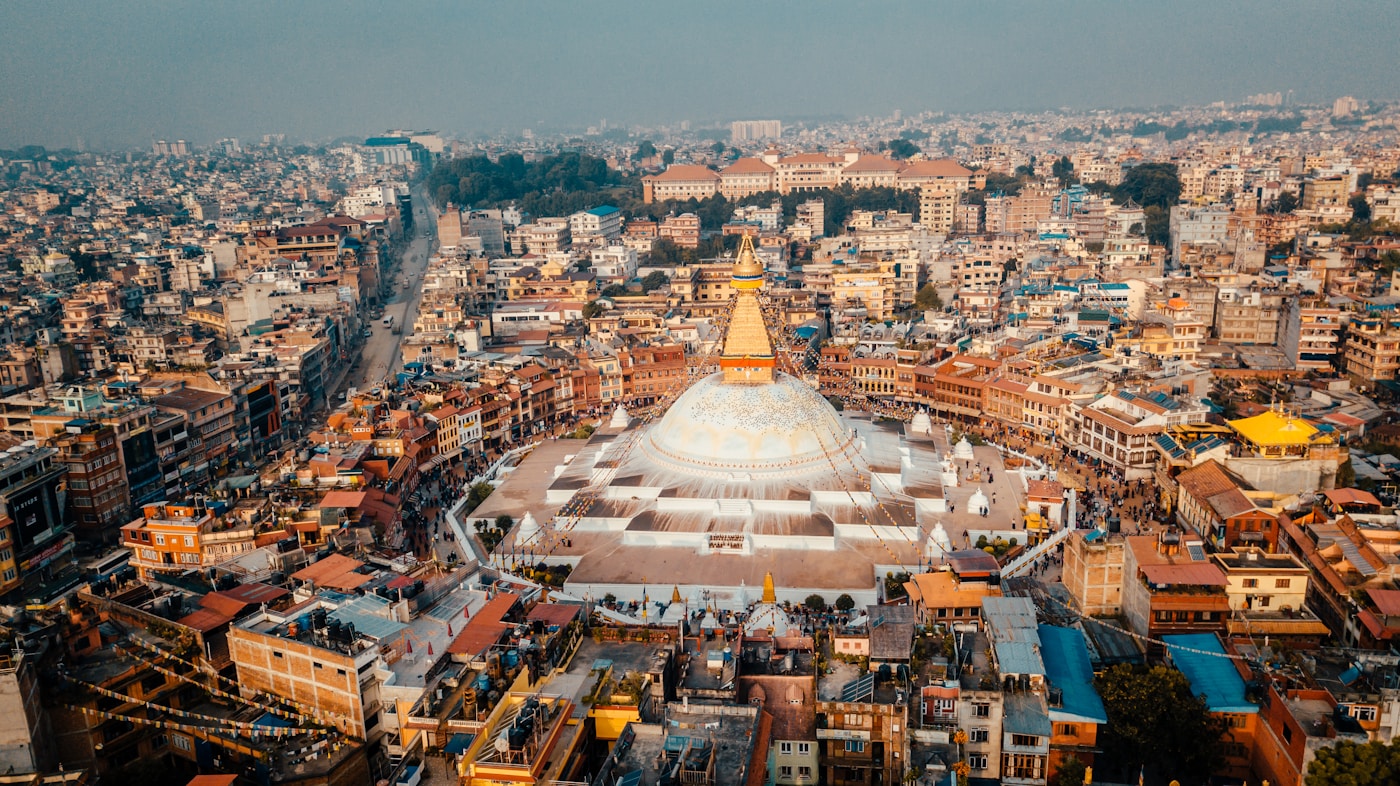
Kathmandu · the Boudhanath Stupa, the largest Tibetan Buddhist stupa outside Tibet
№ 02 , Cost of Living
The math, before the spin.
Every number below comes from Numbeo Q1 2026, cross checked against the Nepal Rastra Bank 2024 household budget survey and the Central Bureau of Statistics Nepal.
Item
Detail
USD per month
Rent, one bedroom, city center
furnished, Thamel or Lazimpat
$280
Rent, one bedroom, outer ring
Patan, Jhamsikhel or Sanepa
$180
Rent, three bedroom, city center
family unit
$580
Groceries
per person, Bhat Bhateni supermarket
$160
Transport
monthly micro bus and tempo
$22
Utilities
electricity, water, gas
$48
Internet
residential fiber, 100 Mbps WorldLink
$24
Dinner for two
mid range restaurant, Thamel
$18
Coffee
flat white, Himalayan Java Coffee
$2.20
Gym
full service, monthly
$28
Single person total
$720
Working couple total
$1,100
A single person budgets $720 a month to live in Kathmandu at the median Numbeo basket. Rent is the largest single line, with a furnished one bedroom in the Thamel tourist district or the Lazimpat embassy quarter commanding $280 a month and an outer ring equivalent in Jhamsikhel, Sanepa, or Patan landing at $180. Most international development professionals and dollar earning remote workers use Wise for the USD to NPR conversion at the Nepal Rastra Bank rate; the NPR is pegged to the Indian rupee at a 1.6 NPR to 1 INR ratio, which makes the cross border arbitrage with Delhi and Indian banking infrastructure straightforward.
Compared regionally, Kathmandu sits 92 percent below London, similar to Dhaka, and 36 percent below Delhi. The cheapest cities ranking places Kathmandu in the South Asian top 10 for value; see also Kathmandu vs Pokhara and the Nepal country page.
Salary equivalence calculator
$ 0
Patan · Patan Durbar Square, the Newari royal compound on the south side of the Bagmati river
№ 03 , Safety
Risk, by the subindex.
No moral panic, no rose tint. Four subindices, referenced to the Nepal Police annual crime report 2024 and the UNODC South Asia regional crime data.
Subindex
Score 0 to 10
Band
Overall safety
6.6
Workable
Solo female safety
6.0
Workable
Family with children
7.2
Workable
Night walk, alone
6.2
Workable
Kathmandu's overall safety score lands at 6.6, in the workable amber band. Nepal's national homicide rate per the UNODC 2024 data was 2.2 per 100,000 residents, among the lowest in South Asia and well below the global median. The structural risks are not violent crime: they are altitude (the 1,400 meter elevation, with day trips to higher passes), traffic (the Kathmandu Valley is one of the most polluted air basins in South Asia, AQI regularly above 150 in winter), earthquake exposure (the 2015 Gorkha earthquake killed 9,000 people and damaged structural housing across the valley), and the structural slow recovery from the 1996 to 2006 Maoist civil war. The workable expat zones are Lazimpat, Maharajgunj, Baluwatar, Jhamsikhel, Sanepa, Patan, and the northern fringe near Boudhanath. The high tourist concentration zones (Thamel, Durbar Marg) carry the elevated petty theft and scam risk normal to a backpacker concentration; the residential outer ring is calmer. SafetyWing covers expat short term insurance; serious tertiary care typically routes to Delhi, Bangkok, or Singapore. The structural risk profile reads more like Yogyakarta than Karachi: low violent crime, high natural and infrastructure baseline risk. See Kathmandu vs Thimphu for the head to head.
№ 04 , Weather
Twelve months at a glance.
The full year, pulled from the national meteorological service 1991 to 2020 normals.
Jan
19°
2°
Feb
21°
4°
Mar
25°
7°
Apr
28°
11°
May
29°
15°
Jun
28°
19°
Jul
27°
20°
Aug
28°
20°
Sep
27°
18°
Oct
26°
13°
Nov
23°
7°
Dec
20°
3°
The climate is classified as subtropical highland, Köppen Cwa on the rim of the Himalayan foothills at 1,400 meters elevation. The defining feature is the wide daily temperature swing and the four distinct seasons: spring (March through May, the most pleasant stretch and the high tourist season, blooming rhododendrons), summer monsoon (June through September, with 80 percent of annual rainfall, frequent afternoon thunderstorms, and flight delays into Tribhuvan International Airport), autumn (October and November, the second high tourist season, the clearest mountain views, the Dashain and Tihar festival cluster), and winter (December through February, dry and cool, with night frost at lower elevations and an AQI air quality crisis in the bowl topography). Annual rainfall is 1,400 millimeters concentrated in the monsoon. The 2,100 sunshine hours a year is moderate. The single most comfortable months are October, November, March, and April. The harshest stretch is January for cold and air pollution, and July for monsoon humidity. The trekking season is October to early December and March to May.
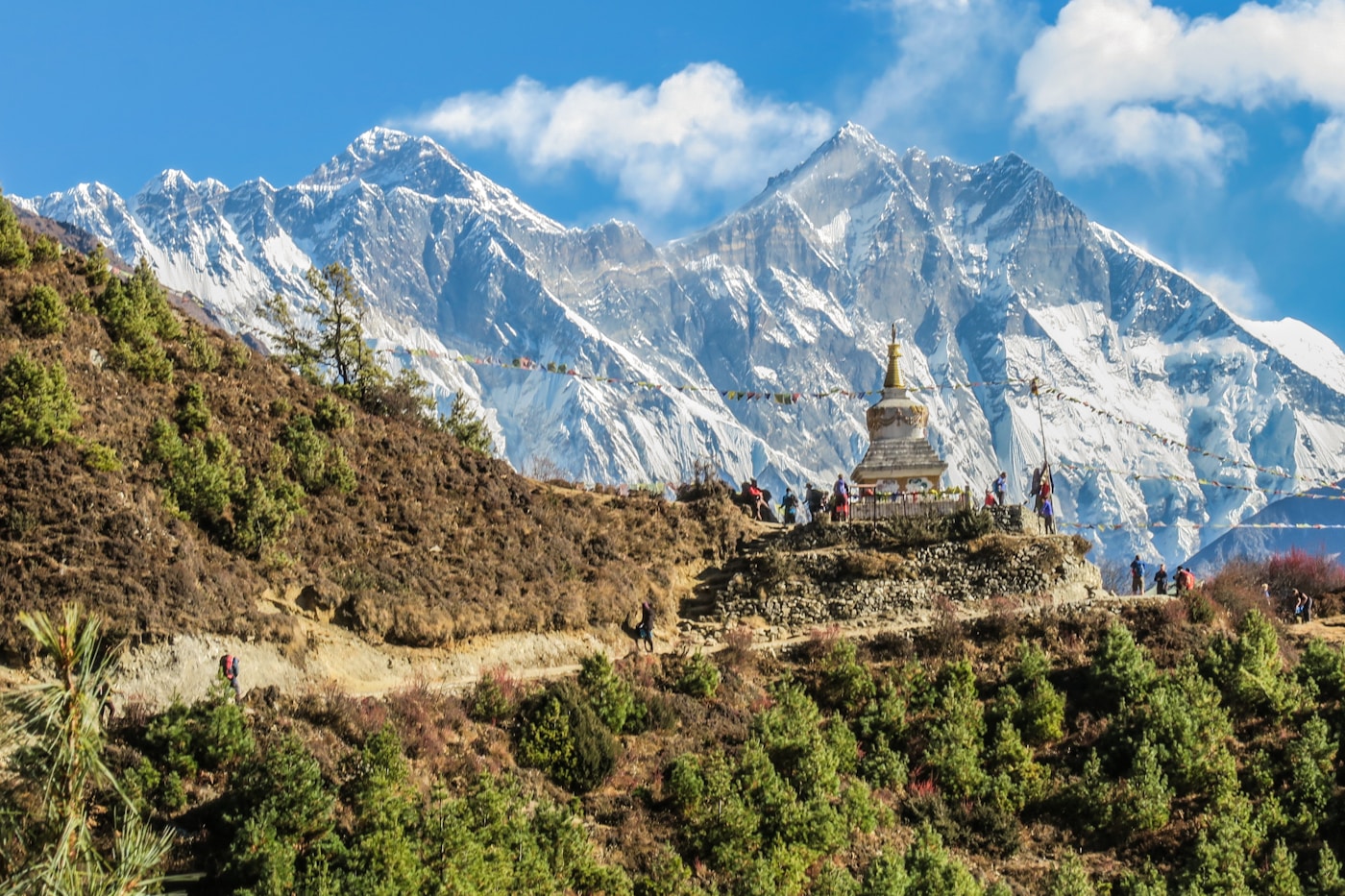
Kathmandu Valley · the foothill setting with the Langtang range to the north on a clear winter morning
№ 05 , Jobs and Salary
Who pays, and how much.
Salaries are gross monthly figures from the national statistics office and the international employer market.
Role
Detail
USD per month, gross
City average
blended sectors
$340
Senior software developer
five plus years, dollar billed remote
$2,200
International NGO program manager
UN or INGO contractor
$3,800
Civil servant
director level
$880
Doctor, public hospital
specialist consultant
$1,400
Personal income tax
top bracket above 5,000,000 NPR a year
36 percent
Employee social security
provident fund plus social security
11 percent
VAT
standard rate
13 percent
Largest employers in metro Kathmandu
The Government of Nepal (the largest single employer, the federal civil service)
Nepal Telecom and Ncell (the two largest telecoms)
Nepal Rastra Bank and the commercial bank cluster (Nabil Bank, NIC Asia, Standard Chartered Nepal)
Tribhuvan University (the largest university and the largest single education employer)
The United Nations system in Nepal (UNDP, UNICEF, UNHCR, WHO, the World Food Programme, OCHA, and the broader donor cluster including the World Bank, ADB, DfID FCDO, USAID, GIZ, JICA, and the Swiss Cooperation)
The garment, carpet, and pashmina export sector (the structural manufactured export base)
Buddha Air, Yeti Airlines, and the trekking and adventure tourism operators (Annapurna Circuit, Everest Base Camp, the Khumbu region)
The Hyatt Regency, the Marriott, the Soaltee Crowne Plaza and the hotel cluster (catering to the donor and trekking traffic)
Kathmandu is the Nepali administrative capital, the financial capital, and the structural single concentration of the national economy: 25 percent of national GDP is generated in the Kathmandu Valley despite housing under 10 percent of the population. The remittance economy from the Nepali diaspora in the Gulf, Malaysia, India, and the United Kingdom is the dominant macroeconomic feature: $11.3 billion in 2024 per Nepal Rastra Bank, representing 26 percent of GDP, one of the highest dependency ratios in the world. For an after tax estimate, run the tax calculator. Wise handles the USD to NPR remittance with the lowest spread in the market.
№ 06 , Neighborhoods
Six quarters, one verdict each.
A working map of where to live in Kathmandu in 2026.
Quarter
Lazimpat
the embassy quarter on the northern axis, mid century stock, the standard expat pick with the UN compound, the Hyatt, and the Indian Embassy nearby.
Quarter
Jhamsikhel and Sanepa
the southern Patan adjacent quarter, the densest international restaurant strip and the modern apartment stock, the popular millennial expat pick.
Quarter
Maharajgunj and Baluwatar
the northern high end residential quarter, large detached stock, the diplomatic and senior government cluster.
Quarter
Patan (Lalitpur)
the historic Newari city across the Bagmati river, the densest cultural fabric, the Patan Durbar Square UNESCO site, the artisan and pottery quarter.
Quarter
Boudha
the northeast Tibetan Buddhist quarter surrounding the Boudhanath Stupa, the Tibetan refugee and monastic concentration, a distinct cultural ecosystem.
Quarter
Thamel
the central tourist concentration, the trekking outfitter strip, the backpacker hostel cluster, not residential but the central commercial node.
Bhaktapur · the brick paved Newari alleys of the eastern Valley city, 13 kilometers east of Kathmandu
№ 07 , Healthcare
The system, and the bill.
Healthcare quality is a 0 to 10 score derived from WHO and national health ministry data.
Kathmandu's healthcare quality score lands at 6.0 on the everycity scale. The structural public anchors are the Bir Hospital (the oldest public hospital in Nepal, founded 1889), the Tribhuvan University Teaching Hospital (Maharajgunj), and the Patan Hospital. The private anchors are the Norvic International Hospital, the Grande International Hospital, the CIWEC Clinic (the historic expat clinic, originally established for the embassy community and the trekking sector, the standard expat first stop), the Vayodha Hospital, and the HAMS Hospital. A specialist consultation at a private hospital runs $30 to $70, an MRI runs $180 to $320, a private overnight room runs $90 to $200. Complex tertiary care (cardiac surgery, oncology, transplant) typically routes to Delhi (AIIMS or Apollo Indraprastha), Bangkok (Bumrungrad), or Singapore. Most international staff and senior expat managers carry private international insurance with MEDEVAC. SafetyWing Nomad Insurance covers Kathmandu with the standard global plan; trekkers should add the helicopter evacuation coverage for any itinerary above 4,000 meters.
№ 08 , Education and Family
For the kids, and the postgrads.
School and university density.
International schools
The Lincoln School Kathmandu (the US accredited K through 12, the longest established international school, since 1954, the structural pull for the US Embassy and donor cluster families)
The British School Kathmandu (the UK national curriculum and IGCSE)
Ullens School (the IB curriculum private school)
Rato Bangala School (the Nepali bilingual academic school, the local elite choice with strong university placement)
The Malpi International School (boarding option, IB and Cambridge curricula)
The Premier International School
Universities
Tribhuvan University (the largest, with 60 plus constituent campuses across Nepal, the central administration in Kirtipur)
Kathmandu University (Dhulikhel, 30 kilometers east; the leading private research university, strong in engineering and computer science)
Pokhara University (with a Kathmandu Valley engineering campus)
Purbanchal University (with Valley campuses)
The Patan Academy of Health Sciences (medical, in Patan)
The Lincoln School Kathmandu (the US accredited K through 12 international school) is the structural anchor for any donor or embassy family on a multi year posting. Tribhuvan University is the largest university system in Nepal but the academic flagship for ambitious Nepali students is increasingly Kathmandu University in Dhulikhel; cross border placement to Indian universities (Delhi University, the JNU cluster, the IITs, and Bangalore) and to the US, UK, and Australian university markets remains a defining feature of the Nepali middle class. The Nepal country page covers the broader education context.
№ 09 , Transport
How the city actually moves.
Walkability, transit, biking and the car question.
Mode
Score
Notes
Walkability
5.8
The dense narrow streets in the historic core are walkable; the broader valley is car dependent; the AQI is a structural binding constraint in winter
Public transit
4.4
Micro buses and tempos run the city network; no metro rail; the inter city long distance bus stations are at Gongabu and the Kathmandu Bus Park
Cycling
4.0
The traffic mix, the air quality, and the steep valley topography are all binding constraints
Car needed
Yes for valley wide; no for in neighborhood
Petrol at $1.20 a liter, parking is informal in residential areas
Kathmandu scores 5.8 on walkability inside the historic Newari quarters (Patan Durbar Square, Bhaktapur, Asan, Thamel) but the valley wide score is structurally lower; the absence of a metro rail system, the predominance of single carriageway roads, and the chronic traffic congestion mean most expat professionals work to a fixed routine of in neighborhood walking plus app based Pathao and InDriver bookings for cross valley trips. The Tribhuvan International Airport (KTM, 6 kilometers east of the city center) is the single national air gateway, with the most reliable connections to Delhi, Doha, Kuala Lumpur, Bangkok, Dubai, and Istanbul. The second Pokhara International Airport (PKR, opened 2023, 200 kilometers west) and the third Gautam Buddha International Airport at Bhairahawa (BWA, opened 2022) provide regional alternatives but with limited long haul service. For occasional short term mobility, rental cars for relocation scouting at KTM run $36 a day for a Maruti Suzuki class car; most expat professionals use a driver hire arrangement at $260 a month rather than self drive given the road conditions.
Thamel · the central tourist quarter, the trekking outfitter strip, and the long established backpacker concentration
№ 10 , Culture and Cuisine
What makes the city itself.
Food signatures, nightlife rating, and the cultural through line.
The food signatures of Kathmandu include the dal bhat (the lentil rice plate, the national daily meal, served with vegetable curry, achaar pickle, pappadam, and seasonal greens), the momo (the steamed or fried Tibetan dumpling, in chicken, buffalo, vegetable, and the spicy jhol mo broth variants), the thukpa (the Tibetan noodle soup, especially in the Boudha quarter), the chatamari (the Newari rice flour pancake, often topped with minced meat and egg), the bara (the Newari lentil cake), the sel roti (the deep fried rice flour ring bread, the festival staple), the choila (the Newari spiced grilled buffalo meat), the gundruk (the fermented leafy green, a sour staple), the Sherpa stew, the Tibetan butter tea, and the Everest, Nepal Ice, and Gorkha beers. The Newari food culture in Patan and Bhaktapur is among the most distinctive in South Asia. For longer reads, the best food cities ranking places Kathmandu in the global top 80 for distinctive cuisine and the best momo cities list naturally places Kathmandu first. Tourism and hospitality cluster in Thamel and Boudha; the nightlife is structurally low key (Nepal has no formal late night drinking culture and bars typically close by 11 PM under municipal regulation). Nightlife sits at a 5.4 rating.
The cultural calendar runs through Dashain (the 15 day Hindu festival in September or October, the structural national holiday cycle), Tihar (the five day festival of lights, late October or early November, with the dog worship day Kukur Tihar that has become viral globally), Holi (March, the spring color festival), Indra Jatra (the Kathmandu specific eight day Newari festival, with the Kumari living goddess procession), the Lhosar New Year (the Tibetan and Newari calendar), and the Buddha Jayanti (the Buddha's birthday in May at Lumbini and Boudhanath). The Kathmandu Valley UNESCO World Heritage cluster (the Kathmandu Durbar Square, the Patan Durbar Square, the Bhaktapur Durbar Square, the Pashupatinath Hindu temple complex on the Bagmati river, the Boudhanath Stupa, the Swayambhunath Monkey Temple, and the Changu Narayan temple) is the densest concentration of UNESCO sites in any urban area in the world. The Garden of Dreams in central Thamel, the Patan Museum (the best curated museum in Nepal), and the Hanuman Dhoka palace anchor the urban cultural ecosystem.
№ 11 , Remote Work
For the laptop, in 2026.
Internet speed, coworking density, nomad visa status, time zone fit.
Variable
Reading
Median residential download
45 Mbps
Coworking spaces in metro
14
Nomad visa
No dedicated digital nomad visa as of May 2026. The standard tourist visa allows 150 days a calendar year. The Non Resident Nepali (NRN) status applies to the diaspora. Long stay requires the Business Visa (proof of investment), the Marriage Visa, or the Study Visa.
Time zone
UTC plus 5:45 year round (Nepal Standard Time, no daylight saving, the only country plus 45 minute offset)
Power reliability
Workable in 2026 after the post 2015 grid reconstruction; the structural load shedding crisis of 2008 to 2017 has been largely resolved by hydropower expansion
The median residential download in Kathmandu runs 45 Mbps; WorldLink, Vianet, and Subisu provide FTTH at 100 Mbps for $24 a month and 250 Mbps for $42 a month. The UTC plus 5:45 time zone is a clean fit for European business hours, partial overlap with East Asia in the morning, and a structural mismatch with US business hours (only the early US East Coast morning overlaps with the late Kathmandu evening). The coworking scene is anchored by NepaLaya, Coworking Nepal, the Hub Coworking Space, and the Yantra coworking cluster in Jhamsikhel. The trekking season (October to December and March to May) draws a heavy laptop nomad community on three to six month rotations. For privacy on Nepali ISP infrastructure, the editorial side note on NordVPN covers the case. Use Wise for the USD to NPR remittance and Booking.com for the first month accommodation in Thamel, Patan, or Jhamsikhel.
Swayambhunath · the Monkey Temple stupa with the iconic eyes of the Buddha on the hilltop west of the city
№ 12 , The Verdict
Kathmandu is the right city, for the right reader.
Move here if you are a UN, World Bank, ADB, FCDO, USAID, GIZ, JICA, or INGO international development professional posted to the Nepal country office, a Himalayan trekking, mountaineering, or adventure tourism operator, a Nepali diaspora returnee from the Gulf, Malaysia, India, or the United Kingdom with established family in the country, a remote worker on the European time zone arbitrage who values the Himalayan setting and the low cost stack, a Buddhist or Hindu spiritual practitioner with serious interest in the Boudhanath, Pashupatinath, or Lumbini ecosystems, or a researcher of South Asian history, anthropology, or development economics.
Kathmandu scored 6.4 on the everycity index because the cost stack at $720 a month is 92 percent below London and 36 percent below Delhi, the Himalayan foothill setting at 1,400 meters elevation with day trips into the Annapurna and Langtang ranges is among the most distinctive geographic settings of any capital city in the world, the Kathmandu Valley UNESCO World Heritage cluster (Kathmandu Durbar Square, Patan, Bhaktapur, Pashupatinath, Boudhanath, Swayambhunath, Changu Narayan) is the densest concentration of UNESCO sites in any urban area on earth, the Newari food culture is among the most distinctive in South Asia, and the international donor cluster (UN, World Bank, ADB, FCDO, USAID, GIZ, JICA) provides a deep professional labor base for the relevant sector.
Do not move here if you cannot work with the structural infrastructure baseline: the AQI in winter regularly exceeds 150 (the Kathmandu Valley bowl topography traps the inversion layer, the brick kiln and diesel generator and vehicle exhaust load is structural, an N95 mask in December and January is the default), the 2015 Gorkha earthquake (7.8 magnitude, 9,000 deaths) is the most recent in a structural seismic cycle and most pre 2015 residential stock has not been retrofitted, the monsoon flight delays into Tribhuvan are routine in July and August, the tertiary medical care is structurally elsewhere (Delhi, Bangkok, Singapore), and the political instability cycle (the 1996 to 2006 Maoist civil war, the 2008 transition to federal republic, the chronic government turnover with seven prime ministers since 2015) shapes the operating environment. Most regret in Kathmandu comes from professionals who arrived expecting Bangkok or Delhi style infrastructure and timelines; Kathmandu works to a different rhythm. The right reader treats the city as a Himalayan basecamp with a deep cultural fabric, not a logistics hub.
Run the relocation score and read Kathmandu vs Pokhara and Kathmandu vs Thimphu.
One city report a week. No fluff, just the numbers behind the move.
Sources and method
Numbeo cost of living Q1 2026; Nepal Rastra Bank 2024 household budget survey and macroeconomic report; Central Bureau of Statistics Nepal 2024 labour force survey; Inland Revenue Department Nepal fiscal 2024 to 2025 income tax schedules; OOKLA Speedtest April 2026; Nepal Police annual crime report 2024; UNODC South Asia regional crime data 2024; Department of Hydrology and Meteorology DHM Tribhuvan station 1991 to 2020 normals; WHO Nepal 2024 country profile; Ministry of Health and Population Nepal hospital ranking 2024; Mercer Quality of Living Survey 2025; World Bank 2025 Nepal country profile. Full method on the methodology page. Figures refreshed on May 16, 2026. Photography: Unsplash.
№ 15, On the map
Where it sits
Kathmandu sits in Asia. For the broader ranking view, the cheapest cities ranking places Kathmandu in context.